
Published on
July 3, 2026
Think about the last thing you bought. You probably searched for it first. A quick question typed into Google, and within seconds, answers showed up.
We all do this every day. We trust those top results without a second thought.
But have you ever stopped to ask how search engines work? How does Google find pages? How does it pick which ones to show you? And why does it rank one site above another? It all comes down to three steps: crawling, indexing, and ranking.
Most people never think about it. Yet for any business, that’s the IMPORTANT part.
Search has also changed a lot in 2026. AI now answers many queries right on the page. So this guide breaks it all down in plain words: the basics, plus what’s new this year
What is a Search Engine: An Overview
A search engine is a tool that helps you find things online. You type a question. It hands you a list of answers. Simple on the surface. But the work behind it runs deep.
Every search engine has two main parts. The first is the search index. Think of it as a giant digital library. It holds details about billions of web pages. Each page Google finds gets a spot inside it.
The second part is the search algorithm. This is the brain of the whole system. It reads your question. Then it picks the best pages from the index and puts them in order.
So one part stores it. The other part sorts. Together, they answer you in less than a second.
One name rules this space. As of April 2026, Google holds about 91.27% of the global search market, while Bing trails far behind at around 5%. Bing, Yahoo, and AI tools fill the gaps. But for most businesses, Google is the game.
Get these search engine basics right, and the rest of how search engines work starts to click.
How Search Engines Deliver Results: 3 Core Steps
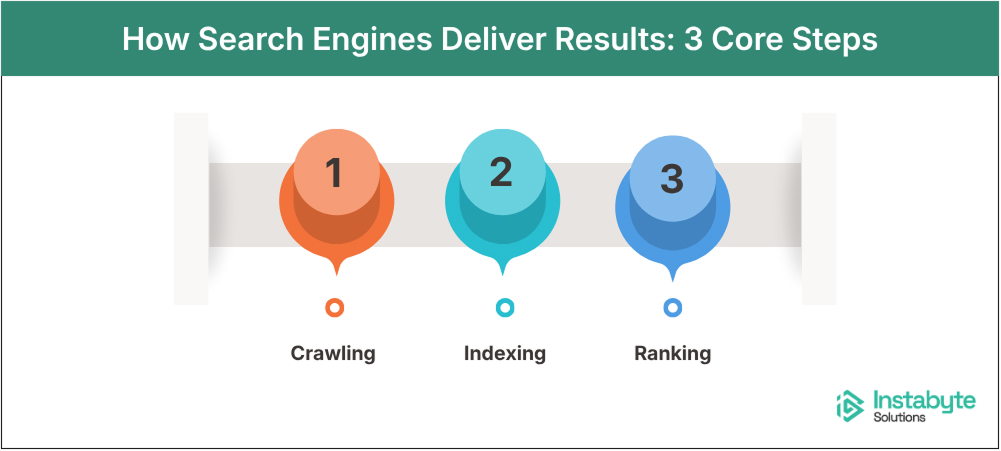
So how does a search engine work? How does your question become an answer? It all runs in three steps. Crawling, indexing, and ranking. Google’s own guide confirms these three stages. But not every page makes it through all three. Let us look at each step.
Step 1: Crawling
First comes crawling. Google sends out small bots for this. People call them web crawlers, spiders, or robots. Google’s bot is named Googlebot. These bots move across the web all day. They jump from one page to the next through links. So a single link can lead them straight to your fresh content. There is a limit, though. Google sets a crawl budget for each site. That’s how many pages it will check in a given window. A slow server can burn through it fast.
Step 2: Indexing
Next comes indexing. Whatever the bots find gets stored. This storage is the search index.
But it saves more than plain text. It keeps your titles, headings, images, and alt text too. It also checks if your page is just a copy of another one. Here’s the key part. If your page is not in the index, it cannot show up. No index spot means no traffic. So getting indexed always comes first. One more thing. Google now reads the mobile version of your site first. This is called mobile-first indexing. A weak mobile page can hurt you here.
Step 3: Ranking
Last comes ranking. This is where the real choice happens. You type a question. The algorithm scans the index. It looks for the most useful pages. Then it sorts them on the search engine results page. Google weighs hundreds of signals to decide this. It checks quality, trust, and relevance. The best match lands on top.
And that’s the full trip. From crawling, indexing, and ranking, this is how search engines work behind the scenes. Three steps, running in seconds, every single time you search.
Crawling vs Indexing vs Ranking: Quick Comparison
Still mixing up the three steps? Many people do at first. Most people blur them together. But each one does a very different job. Let’s line them up side by side.
| Stage | What Happens | Why It’s Critical for You |
| Crawling | Bots find your pages by following links. | If bots can’t reach a page, it stays invisible. |
| Indexing | Google stores and sorts your page data. | No index spot means no chance to rank. |
| Ranking | The algorithm orders results by relevance. | Better signals push you higher up the page. |
Here’s the easiest way to picture it. Think of the three steps as a funnel.
- At the top sits crawling. Google has to find your page first. If a bot can’t reach it, nothing else matters.
- In the middle comes indexing. Once found, your page needs a spot in Google’s library. A page that isn’t stored simply can’t appear in results.
- At the bottom sits the ranking. This is the final filter. Out of all the stored pages, Google decides which page shows first.
So a page must clear each stage in order. Skip one, and you drop out before real users ever see you. Get all three right, and you give yourself a real shot at page one. This is why smart SEO works on all three, not just one. Great content means nothing if bots can’t crawl it. A fast site means nothing if the page never gets indexed. Each step builds on the last.
What Makes a Page Rank Higher in 2026?
So your page is crawled and indexed. What pushes it up now? Google uses many signals to decide. Its own guide confirms this. The algorithm sorts pages by relevance and quality. Nobody knows the full list. But a few search engine ranking factors matter most. Here are the ones worth your time.
#1. Backlinks
A backlink is a link from another site. It points back to your page. Google treats it like a vote. A trusted link builds your reputation. But quality beats quantity here. One good link beats fifty weak ones. But cheap, spammy links can pull you down. So never buy links in bulk. Earn them instead. Create content others want to share.
#2. Relevance and Search Intent
Relevance means your page answers the question. Google reads the search intent too. It looks past your exact words. Take “best running shoes,” for example. That searcher wants a product list. They don’t want a history lesson. A mismatch pushes your page down. So think before you write. Ask what the reader really wants. Then build your page around it.
#3. Helpful Content and E-E-A-T
Google rewards content made for people. Its quality lens is called E-E-A-T. It means experience, expertise, authority, and trust. In plain words, Google asks four things. Has the writer really done this? Do they know the topic well? Does the web respect them? Can readers trust the page? You show this with real know-how. Add your own insight. Name your authors clearly. Keep your facts honest.
#4. Page Speed and Core Web Vitals
A slow page pushes visitors away. Google tracks this with Core Web Vitals. These measure loading, response, and stability. They work like a tiebreaker. Imagine two pages with equal content. The faster one usually wins. Speed alone won’t save weak content. But it often decides close races. So a fast site gives you an edge.
#5. Mobile Experience
Most searches now happen on phones. So Google reads your mobile version first. This is called mobile-first indexing. Your mobile page is not the “extra” one. It is the main version now. Broken layouts and tiny text hurt you. Test your own site on a phone. Does it feel slow or clunky? Then Google likely feels it too.
No single factor works on its own. Google looks at all of them together. So work on each one, step by step. Improve your backlinks and your content. Boost your speed and mobile design. Do this, and your rankings will grow.
Why Do Search Engines Show Different Results to Different People?
Here’s something most people miss. You and a friend can search for the same thing. But you both see different results. Why does this happen? Google personalizes what it shows you. It uses a few simple clues to do this.
- Location is the biggest clue. Say you search for “coffee shop near me.” In Delhi, you won’t see cafes like those in Mumbai. Google reads your local search intent. Then it shows what sits close to you.
- Language plays a part too. Google serves results in your language. So a Hindi user sees different pages. An English user sees another set.
- Search history matters as well. Google notes the pages you click. It uses them to shape your next results.
So there is no single “top” spot. Your rank can shift from city to city. It can change from one person to the next. That is why local SEO helps small businesses so much.
The 2026 Shift: AI Search, Zero-Click, and AEO

Here’s what most guides will not tell you. Search has changed a lot lately. The last two years shifted everything. Old basics alone are not enough now. So let’s see what’s really new.
AI Overviews and AI Mode
Open Google today and look at the top. You will often see an AI overview there. It is an AI-written summary of your answer. These now show on over 20% of searches. And they cut clicks to websites sharply. Google also rolled out AI Mode. It works like a full chat search. It passed one billion monthly users in 2026. Search is now a conversation.
The Rise of Zero-Click Searches
This brings a big shift: zero-click searches. These end without any click to a site. The numbers here are striking. In early 2026, about 68% of searches ended without a click. People read the answer and move on. So ranking first is not the only goal. Being seen in that answer matters too.
AI Search Engines and AEO
People do not just use Google now. They ask for tools like ChatGPT and Gemini. Perplexity is popular as well. These AI search engines pull answers from the web. Then they reply in plain words. This created a new skill: Answer Engine Optimization (AEO). Old SEO got you ranked. AEO gets you quoted in AI answers. The goal has grown wider now. You still want to rank well. But you also want AI tools to trust your brand.
Your Next Step: Grow With Smart SEO
So what should you do with all this? Knowing how search works is step one. Using it is where growth begins.
Start with helpful, original content. Answer the real questions people ask. Then keep your site healthy too. Let Google crawl every key page. Fix your slow load times. Check how it looks on a phone. Serving a local area? Then local SEO is gold. Set up your Google Business Profile. Collect honest reviews as well. Also, get ready for AI search. Aim to be the source for AI tool quotes. Don’t settle for just a blue link.
This is a lot to manage alone. You don’t have to do it solo. Want results without trial and error? The team at Instabyte Solutions can help. Our professional SEO services are built for growth. We help you rank higher on Google. And we keep you visible as search changes.
Final Thoughts
So now you know the search engine basics. You have seen the full journey. It goes from crawling to indexing to ranking. You also saw what changed in 2026. AI overviews and zero-click results are here. AI search is reshaping the whole game.
Here is the simple truth. Search rewards sites that are easy to find. It rewards fast, helpful pages too. Master these, and page one comes closer. The rules keep shifting over time. But the main goal stays the same. Just be the answer people trust.
Ready to grow your visibility in AI overviews? Get a free AI-SEO consultation today. Let us take the first step together.
Quick Answers to Common Questions
How do search engines work step by step?
Search engines follow three main steps. First, a bot finds your page. This part is called crawling. Next, Google stores your page in its database. This step is known as indexing. Then it picks the best pages for each search. That final step is ranking.
What are the 3 stages of a search engine?
There are three simple stages. The first stage is crawling. A bot finds your web page. The second stage is indexing. Google saves your page in its records. The third stage is ranking. It decides your spot in the results.
How does Google decide which website ranks first?
Google checks many things at once. It looks at how relevant your page is. It reviews your content quality and backlinks. It also checks your page speed and mobile design. The page that fits the search best often wins the top spot.
Do search engines still matter with AI tools like ChatGPT?
Yes, they still matter a lot. Most people open Google first. AI tools also pull their answers from ranked pages. In fact, about 68% of Google searches now end without a click. So your visibility in those answers is very important.
How do I get my website on the first page of Google?
Start with the basics and stay steady. Write helpful content for real people. Match your pages to what users search. Earn quality backlinks from trusted sites. Keep your site fast and easy on mobile. This effort slowly moves you toward page one.




June 17, 2025
Top 10 Web Design Companies in Mumbai: Have a Look


August 27, 2026
Content Marketing ROI: How to Measure It

More Blogs
Visit Our Latest Blog!

Your project deserves the best, contact us today and let's make it happen.
Consult Now